
If your dog suddenly starts limping, has trouble getting up, or seems reluctant to run, jump or climb any stairs, your vet will likely examine their cranial cruciate ligament (CCL) for a possible tear. Similar to the anterior cruciate ligament (ACL) in humans, especially athletes, the CCL helps to stabilize the knee. In dogs, more than 95% of CCL tears are due to an underlying degenerative process of the ligament, while fewer than 5% are caused by trauma just like in humans. CCL ruptures are the most common orthopedic disease we see in our canine companions. When the ligament tears, the resulting instability in the knee can make everyday tasks painful and difficult for your dog.
One of the most commonly recommended treatments for a significant CCL injury is a tibial plateau leveling osteotomy (TPLO). For many dogs, TPLO can provide a stable knee and help them return to an active lifestyle.
What is TPLO surgery?
TPLO is an orthopedic procedure designed to stabilize a dog’s knee after the CCL has been damaged or torn.
Instead of replacing the damaged ligament, the doctor performing the surgery changes how the knee operates. During surgery, the angle of the tibial plateau is decreased to make the top of the tibia more level and prevent the femur from sliding down the back of it. So, when the dog puts weight on the limb, the joint is more stable without a functioning CCL.
Because TPLO involves cutting and repositioning bone, it is considered a major orthopedic procedure with a lengthy recovery. However, the surgery has been used successfully for many years and is commonly preferred by veterinarians.
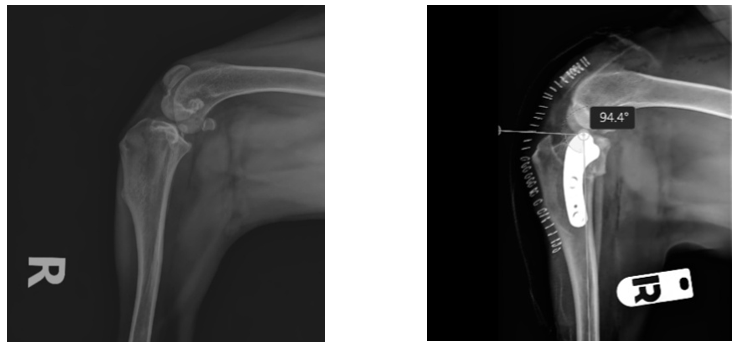
Before TPLO After TPLO
Why would a dog need TPLO?
In short, the most common reason is a torn or partially torn CCL.
CCL injuries are due to gradual degeneration of the cranial cruciate ligament, often without any associated trauma. We still do no completely understand why dogs are predisposed to CCL ruptures. However, there is likely a genetic, hormonal and anatomic component to it.
A CCL injury can lead to:
- Pain and lameness
- Difficulty standing or sitting
- Reluctance to run, jump or climb stairs
- Reduced activity
- Muscle loss in the affected limb
- Knee instability
- Progressive arthritis
Once the CCL is torn, the knee remains unstable and will become progressively worse overtime. The knee’s instability can damage other structures inside the joint which in turn can contribute to arthritis.
What should you expect?
Before surgery, your veterinarian will require a physical examination and may recommend x-rays and lab work. Imaging helps evaluate the knee and plan the procedure whereas lab work is a pre-anesthetic safety check for your dog. The procedure is thus performed under general anesthesia, and dogs typically receive pain medication before and after surgery.
Recovery is an important aspect of whether or not your pet has a successful TPLO procedure. Since the bone needs time to heal, your dog’s activity will be significantly restricted for 8 weeks after surgery. Over time, your dog’s activity level can gradually increase as the bone heals. However, a few common restrictions a veterinarian may impose on your dog post-surgery are as follows:
- Short, controlled leash walks
- Keeping your dog confined to a small area when unsupervised
- Avoiding running, jumping, stairs and rough play
Many dogs tend to not follow the veterinarian’s orders and may begin over-using their leg soon after surgery, but this does not mean the knee is fully healed. Healing a bone typically takes several weeks and returning to regular activity too early can increase the risk for post-surgical complications.
Following your veterinarian’s restrictions and recommendations is important for a successful recovery.
What are the risks?
Like any major surgery, TPLO has potential risks. These can include infection, delayed bone healing, injury to the meniscus, flare-ups of osteoarthritis, need for implant removal or other complications. Additionally, dogs who experience a CCL tear in one knee have an approximately 50% chance of developing a tear in the opposite limb. By carefully following postoperative instructions and closely monitoring your pet’s recovery, you can help reduce the risk of complications.
Contact your veterinarian if you begin to notice any signs of increased swelling, significant pain, discharge from the incision, sudden worsening of lameness, or any other concerning changes.
To Recap
A torn CCL can be quite painful and can make a dog’s knee unstable. TPLO surgery may be recommended by your veterinarian to stabilize the knee. This procedure will change the biomechanics of the joint instead of replacing the damaged ligament.
Not all dogs are good candidates and your veterinarian will determine your pet’s eligibility during their surgical consultation. If the procedure is deemed appropriate for your dog, TPLO can be an effective way to restore comfortable function and help a dog get back to their active lifestyle. Your pet’s outcome after surgery largely depends on the amount of osteoarthritis present at the time of surgery. The longer a knee remains unstable, the more arthritis will accumulate.
So, if your dog is limping or has been diagnosed with a CCL injury, talk with your veterinarian about your pet’s options and see if your dog is eligible for TPLO surgery. Every dog is different but it’s best to follow your veterinarian’s recommendation to sooner better their overall health and well-being.